
The Hidden Signs of Nutrient Deficiencies

We often wait until we're "sick" to pay attention to our health. But usually, our bodies have been whispering for months through small physical changes — a spot on a nail, a crack at the corner of the mouth, a patch of rough skin. These aren't cosmetic issues. They're invitations to look deeper at your nutrition, your gut health, and your absorption. Check your nails right now. Here's what they might be telling you.
White spots on your nails
Small white flecks — leukonychia
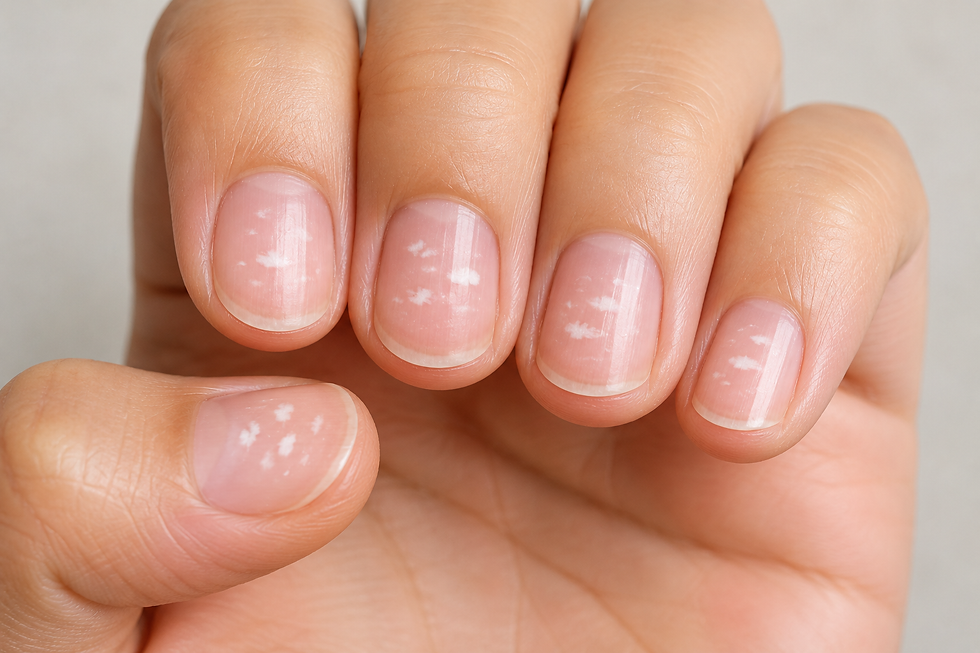
Those small white flecks on your nails aren't from bumping your hand — they're one of the most common physical signs of zinc deficiency. Zinc is involved in over 300 enzymatic reactions and is critical for immune defense, gut lining integrity, and hormone production.
THE SIGN
Small white flecks or patches across one or more nails (leukonychia).
THE DEFICIENCY
Zinc — commonly missed on standard blood panels
WHY IT MATTERS
Zinc drives immune function, skin repair, and gut lining health.
Cracked corners of the mouth
Redness or painful cracks — angular cheilitis

Painful, persistent cracks at the corners of your mouth — angular cheilitis — are rarely about dry weather. They're almost always a signal of B-vitamin (B2 or B12) or iron deficiency, nutrients essential for energy production and skin cell repair.
THE SIGN
Redness, soreness, or cracking at the corners of the lips
THE DEFICIENCY
B2 (riboflavin), B12, or Iron
WHY IT MATTERS
These nutrients drive energy metabolism and keep skin barriers intact
Vertical ridges on your nails
Lines running from cuticle to tip

Vertical nail ridges are often passed off as aging — but in functional medicine they're a flag for low stomach acid (HCl). When HCl is insufficient, you can't properly break down protein or absorb key minerals, no matter how well you eat.
THE SIGN
Prominent lines running lengthwise from the base to the tip of the nail.
THE DEFICIENCY
Low stomach acid (HCl) impairing mineral absorption.
WHY IT MATTERS
It's not just what you eat — it's what you actually absorb.
The twist: You could be eating a perfectly nutrient-dense diet and still be deficient. Low stomach acid means proteins and minerals pass through without being properly broken down or absorbed. This is why testing matters more than guessing.
"Chicken skin" on your arms
Small rough bumps — keratosis pilaris

Those small, rough, sandpaper-like bumps on the backs of your arms are known as keratosis pilaris — and they're a classic sign of Vitamin A or Omega-3 fatty acid deficiency. These nutrients are critical for skin cell turnover and keeping systemic inflammation in check.
THE SIGN
Small, rough bumps on the back of the upper arms or thighs.
THE DEFICIENCY
Vitamin A and/or Omega-3 fatty acids.
WHY IT MATTERS
Both are essential for skin cell turnover and reducing whole-body inflammation.
Fix it with food first: Grass-fed liver and eggs for vitamin A; fatty fish, walnuts, and flaxseed for Omega-3s. If symptoms persist, test — don't guess.
⚠️ A note on self-supplementing:
Seeing these signs is the first step — but "Dr. Google" can lead to over-supplementing, which carries its own risks (especially with fat-soluble vitamins like A). In functional medicine, we use advanced testing to see exactly what your cells are missing so we can replenish them strategically — not blindly.
This article is for educational purposes only and does not constitute medical advice. Always consult with a qualified healthcare provider before starting any supplement protocol. © 2026 Nomad Functional Medicine. All rights reserved.


Comments